
42/2009
Collection
Paintings, Prints and Drawings
Brief description
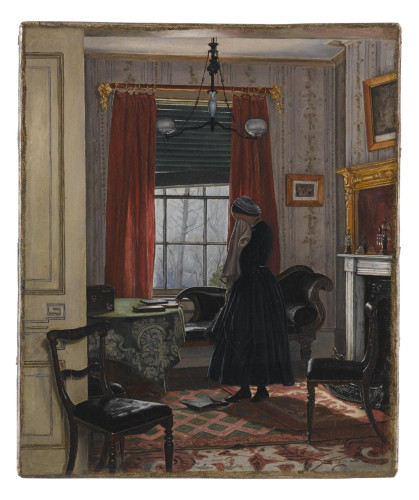
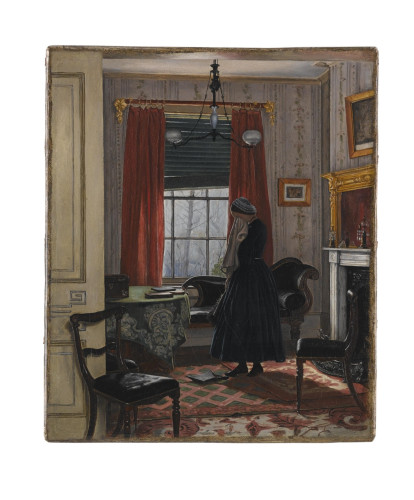
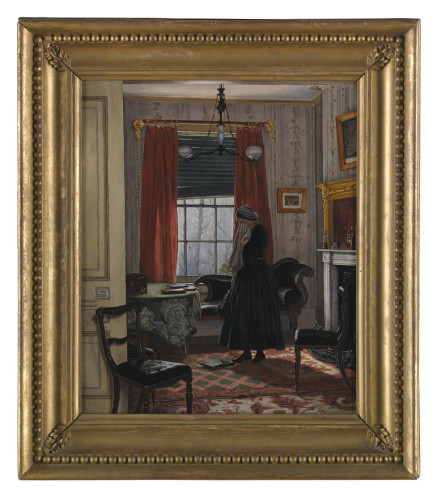
‘The First Place’, a domestic interior scene with a crying maid, oil on canvas by A. Erwood, it was exhibited at the Royal Academy in 1860, in a gilt and moulded frame.
Title
The First Place
Object name
painting
oil painting
oil painting
Object number
42/2009
Location
On Display
Production person
A. Erwood (artist)
Production date
1860 (painted)
Production place
London (painted)
Period
Victorian (1837-1901)
Material
oil paint
canvas
gilt
canvas
gilt
Technique
painted
Physical description
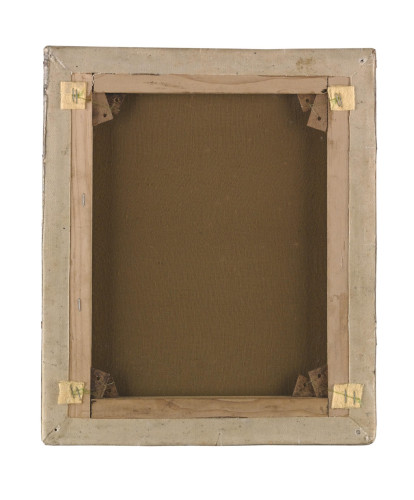
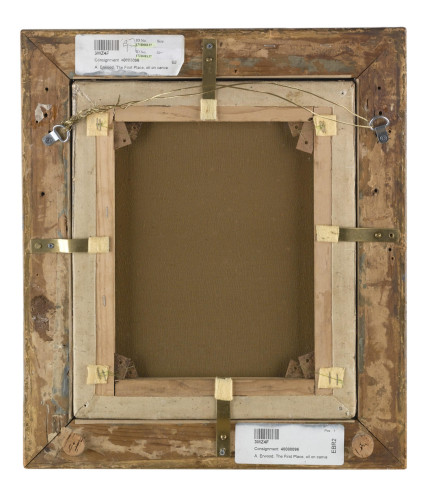
Painting, oil on canvas, glazed and framed, in a gilt wood frame, simply decorated with a row of beading and a small leaf moulding at each corner.
Content description
This small painting is a detailed depiction of a domestic interior with a maid crying. She is shown holding her apron up to her face with her left hand. The brush she has been using to sweep the hearth or the carpet is in her right hand and the dustpan is on the floor by her foot. The furnishings of the interior include three chairs and one couch with seats upholstered in black horsehair and a circular table covered with a green tablecloth with a patterned border. The floor is covered with a red and white floral patterned carpet, with two rugs layered over this. A floral striped wallpaper in a light colour is shown on the walls and the window has a half pulled blind and a pair of red curtains, which have been hung with curtain rings on a pole ornamented with fancy gilt metal curtain pole ends. Above the fireplace there is a gilded overmantel mirror, with a painting hung above this. Three ornaments, two lustres and a shell, can be seen on one half of the mantelpiece and the fireplace, fender and fire tools are visible behind a chair. A lamp with two glass shades hangs from the centre of the ceiling.
Dimensions
Height: 31.5cm
Width: 26.2cm
Height: 40.9cm
Width: 35.5cm
Height: 24.7cm
Width: 29.8cm
Width: 26.2cm
Height: 40.9cm
Width: 35.5cm
Height: 24.7cm
Width: 29.8cm
Website keywords
ceiling treatments
doors
floor treatments
living room furniture
seating
tables
mirrors
pictures
textiles
wall treatments
window treatments
fireplaces
fire tools
cleaning
images of living rooms
Lighting
ornaments
doors
floor treatments
living room furniture
seating
tables
mirrors
pictures
textiles
wall treatments
window treatments
fireplaces
fire tools
cleaning
images of living rooms
Lighting
ornaments
Label
Label text for the digital interactive located in the Reading Room (September 2015- June 2017):
‘The First Place’
By A. Erwood
Oil on canvas, exhibited in 1860
Many of the works exhibited by A. Erwood were domestic scenes with themes of loneliness and separation. The maid has dropped her dustpan in a fit of tears, and the title tells us that she is overcome with the difficulties of her ‘first place’ in a job away from home. The focus on the experience of a servant is unusual, and provides a different perspective on domestic life.
The painting also provides accurately drawn furnishing detail from the period, including the use of a combination of layered rugs and carpets.
Label text for Recent Acquisitions case, Geffrye Museum, 2009:
The First Place by A. Erwood (fl.1860-1869)
Exhibited in 1860, oil on canvas
This painting was recently acquired by the Geffrye Museum from the sale of Sir David and Lady Scott's collection at Sotheby's, London.
What little is known of the artist's story is intriguing. S/he is recorded as exhibiting at the Royal Academy between 1860 and 1869, when s/he provided addresses in south London. The titles of the exhibited paintings, two of which are in German, show a recurring theme of separation and loneliness. The final painting of 1869 is poignantly titled Quite alone and others include Writing to mother and Er kommt nicht [He doesn't come]. The present work shows the sadness of a maid in her first position, separated from home.
The painting is full of furnishing and decorating details, accurately drawn - the fancy curtain pole ends, for example, of flowers spewing forth more flower heads, can be found in trade catalogues of the period (see illustration). Of particular interest is the combination of carpets - a fitted one followed by a drugget and a hearthrug and the way in which all these patterns and the wallpaper are put together. Paintings of run-of-the-mill middle-class interiors showing so much furnishing detail are very rare and such detailing of mainstream taste makes this modest painting exceptional.
Acquired for £13,750 ex VAT with support from The Art Fund and the MLA/V&A Purchase Grant Fund.
‘The First Place’
By A. Erwood
Oil on canvas, exhibited in 1860
Many of the works exhibited by A. Erwood were domestic scenes with themes of loneliness and separation. The maid has dropped her dustpan in a fit of tears, and the title tells us that she is overcome with the difficulties of her ‘first place’ in a job away from home. The focus on the experience of a servant is unusual, and provides a different perspective on domestic life.
The painting also provides accurately drawn furnishing detail from the period, including the use of a combination of layered rugs and carpets.
Label text for Recent Acquisitions case, Geffrye Museum, 2009:
The First Place by A. Erwood (fl.1860-1869)
Exhibited in 1860, oil on canvas
This painting was recently acquired by the Geffrye Museum from the sale of Sir David and Lady Scott's collection at Sotheby's, London.
What little is known of the artist's story is intriguing. S/he is recorded as exhibiting at the Royal Academy between 1860 and 1869, when s/he provided addresses in south London. The titles of the exhibited paintings, two of which are in German, show a recurring theme of separation and loneliness. The final painting of 1869 is poignantly titled Quite alone and others include Writing to mother and Er kommt nicht [He doesn't come]. The present work shows the sadness of a maid in her first position, separated from home.
The painting is full of furnishing and decorating details, accurately drawn - the fancy curtain pole ends, for example, of flowers spewing forth more flower heads, can be found in trade catalogues of the period (see illustration). Of particular interest is the combination of carpets - a fitted one followed by a drugget and a hearthrug and the way in which all these patterns and the wallpaper are put together. Paintings of run-of-the-mill middle-class interiors showing so much furnishing detail are very rare and such detailing of mainstream taste makes this modest painting exceptional.
Acquired for £13,750 ex VAT with support from The Art Fund and the MLA/V&A Purchase Grant Fund.
-
© Museum of the Home, London
-
© Museum of the Home, London
-
© Museum of the Home, London
-
© Museum of the Home, London
-
© Museum of the Home, London


