1/2008
Collection
Furniture
Brief description
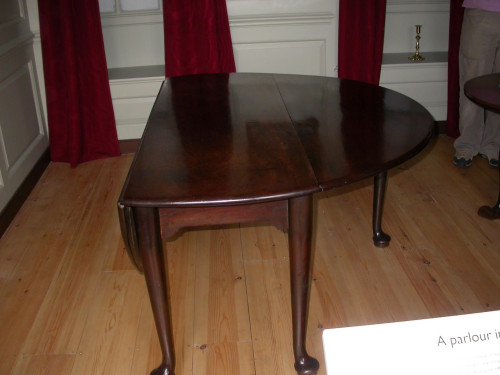
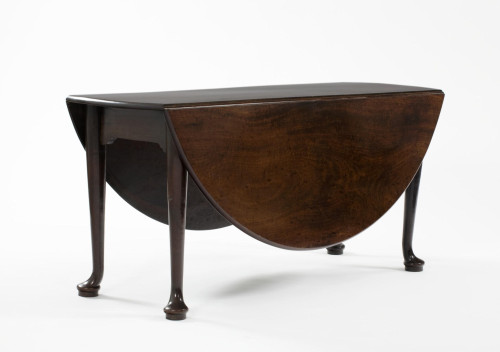
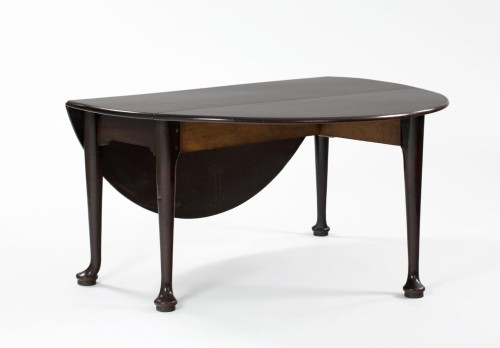
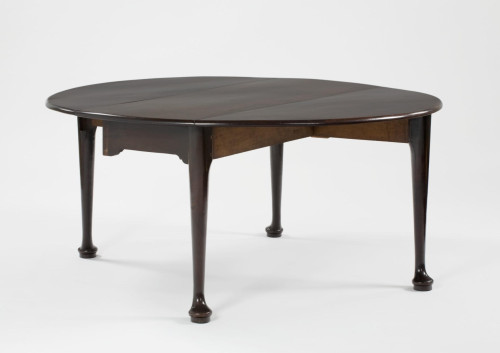
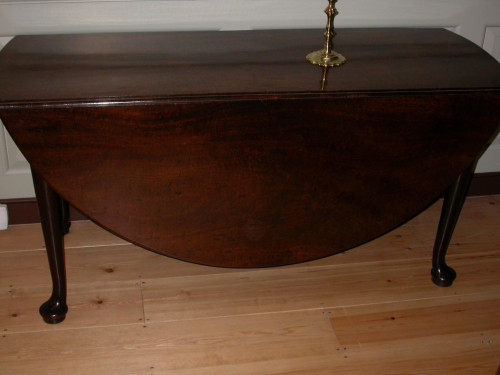
Oval mahogany drop-leaf dining table, retaining fragments of three trade labels belonging to Giles Grendey’s workshop, made in London c.1740.
Object name
table
Object number
1/2008
Location
On Display
Production person
Giles Grendey (manufacturer)
Production date
c.1740 (manufactured)
Production place
London (manufactured)
Period
Georgian (1714-1837)
Material
mahogany
iron
paper
beech
iron
paper
beech
Technique
turned
joined
glued
joined
tenoned
nailed
joined
glued
joined
tenoned
nailed
Physical description
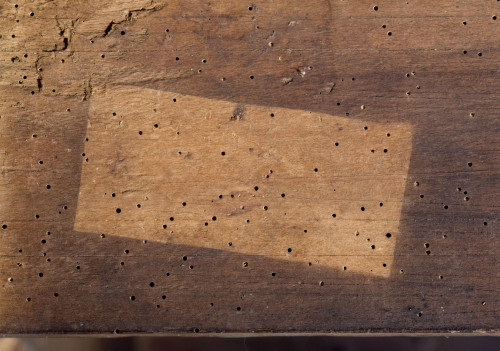
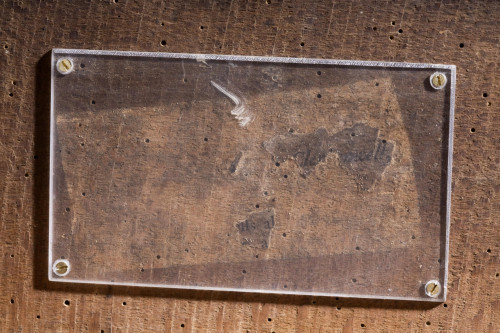
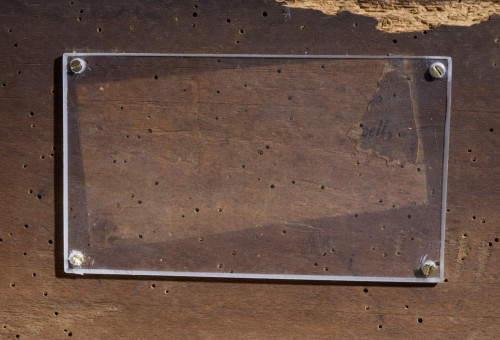
Mahogany ‘gateleg’ or oval dining table, with an oval top with shaped end rails, on turned and tapered legs with pad feet. The table has the remains of three labels; one on the inside side rail, and one on each side of the bracing rail. The first and second have disappeared almost completely; the third has disappeared completely leaving only a witness mark. The last label is pasted upside down, and the word 'Clerkenwell' is discernable.
The top is composed of three boards varying between 51 and 53 cm in width, and measuring approximately 21 mm thick (or ¾ inch). The leaves are fixed by three iron hinges on each side, each of which is secured by six screws (three on each side). The table has rule joints. The top is fixed to the frame by six dome-headed screws, one screw in each of the end rails, two screws in each of the fixed beechwood frames.
The frame has solid mahogany end rails, measuring approximately 25 mm or 1 inch thick. Each rail is tenoned into the top of one leg; the other end is dovetailed with a lapped joint into a thin beechwood side rail which extends just less than half the length of the table. It is nailed to, and overlaps by about 10 cm, a much thicker beechwood rail which extends the length of the table as far as the opposite fixed leg. The other end of the thicker rail terminates in a knuckle joint with the beechwood flyrail, the other end of the flyrail is tenoned into the moveable leg and double pegged. The construction of the other half of the frame is a mirror image of the first. There is a beechwood bracing rail half way down the frame perpendicular to the rails and fixed to them with a double foxed tenon.
The top of the table is a deep mahogany brown in colour; the centre is lighter than the leaves. There is a heavy but even patination all over the table. The centre of the top has a few ink or iron stains and some minor scratches. It is otherwise in good condition. There is a very small chip to one end of the rule joint on one leaf. The end rails are heavily patinated with traces of several different finishes. One end rail has a split extending from the open end for about 60 mm. The pegs securing the fixed legs to the beechwood rails, and the flyrails, may not be original. All the beechwood elements of the frame have worm damage. The underside of the top appears relatively untouched; it is dark and heavily oxidised but with few traces of varnish or any other finish except around the edges. The beechwood rails are likewise untouched and naturally oxidised. The centre board of the top has a very slight convex warp.
The object was physically marked with its Object Number on 08/02/2010. Marked on the underside of one of the shorter horizontal panels.
The top is composed of three boards varying between 51 and 53 cm in width, and measuring approximately 21 mm thick (or ¾ inch). The leaves are fixed by three iron hinges on each side, each of which is secured by six screws (three on each side). The table has rule joints. The top is fixed to the frame by six dome-headed screws, one screw in each of the end rails, two screws in each of the fixed beechwood frames.
The frame has solid mahogany end rails, measuring approximately 25 mm or 1 inch thick. Each rail is tenoned into the top of one leg; the other end is dovetailed with a lapped joint into a thin beechwood side rail which extends just less than half the length of the table. It is nailed to, and overlaps by about 10 cm, a much thicker beechwood rail which extends the length of the table as far as the opposite fixed leg. The other end of the thicker rail terminates in a knuckle joint with the beechwood flyrail, the other end of the flyrail is tenoned into the moveable leg and double pegged. The construction of the other half of the frame is a mirror image of the first. There is a beechwood bracing rail half way down the frame perpendicular to the rails and fixed to them with a double foxed tenon.
The top of the table is a deep mahogany brown in colour; the centre is lighter than the leaves. There is a heavy but even patination all over the table. The centre of the top has a few ink or iron stains and some minor scratches. It is otherwise in good condition. There is a very small chip to one end of the rule joint on one leaf. The end rails are heavily patinated with traces of several different finishes. One end rail has a split extending from the open end for about 60 mm. The pegs securing the fixed legs to the beechwood rails, and the flyrails, may not be original. All the beechwood elements of the frame have worm damage. The underside of the top appears relatively untouched; it is dark and heavily oxidised but with few traces of varnish or any other finish except around the edges. The beechwood rails are likewise untouched and naturally oxidised. The centre board of the top has a very slight convex warp.
The object was physically marked with its Object Number on 08/02/2010. Marked on the underside of one of the shorter horizontal panels.
Dimensions
Height: 71cm
Width: 157cm
Width: 55cm
Width: 157cm
Width: 55cm
Website keywords
tables
dining furniture
dining furniture
Label
Label text for the exhibition At Home with the World, Geffrye Museum (20 March 2012- 9 September 2012):
Table
This ‘gateleg’ table is made of mahogany, a wood imported from overseas colonies, in the Caribbean. It can be folded out to make a larger surface for meals. Formal dining in the early eighteenth century was in the French style (à la Française); diners helped themselves to a selection of dishes at once, making an oval table ideal.
Table
This ‘gateleg’ table is made of mahogany, a wood imported from overseas colonies, in the Caribbean. It can be folded out to make a larger surface for meals. Formal dining in the early eighteenth century was in the French style (à la Française); diners helped themselves to a selection of dishes at once, making an oval table ideal.
-
© Museum of the Home, London
-
© Museum of the Home, London
-
© Museum of the Home, London
-
© Museum of the Home, London
-
© Museum of the Home, London
-
© Museum of the Home, London
-
-