29/2006
Collection
Furniture
Brief description
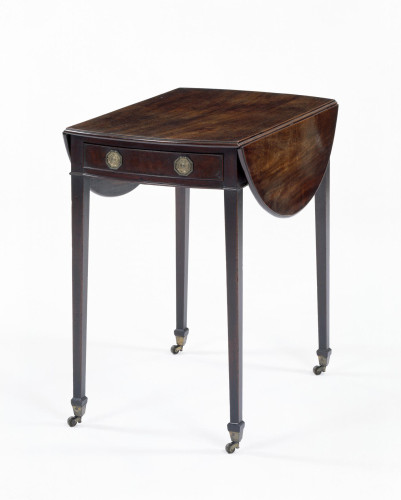
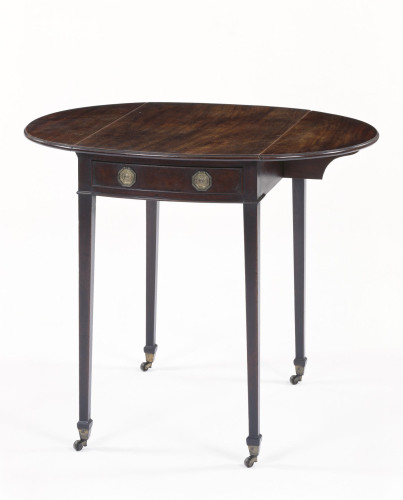
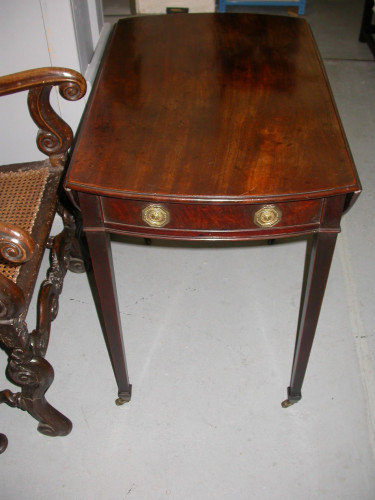
Mahogany pembroke table, with an oval top and frieze drawer, on brass castors. Manufactured in England in c.1785.
Object name
table
pembroke table
pembroke table
Object number
29/2006
Location
On Display
Production date
c.1785 (manufactured)
Production place
England (manufactured)
Period
Georgian (1714-1837)
Material
mahogany
metal
oak
deal
beech
brass
metal
oak
deal
beech
brass
Technique
tenoned
screwed
veneered
screwed
veneered
Physical description
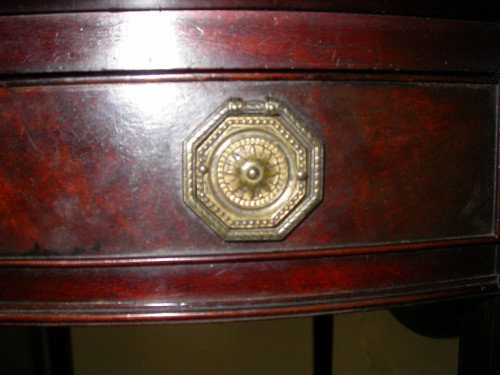
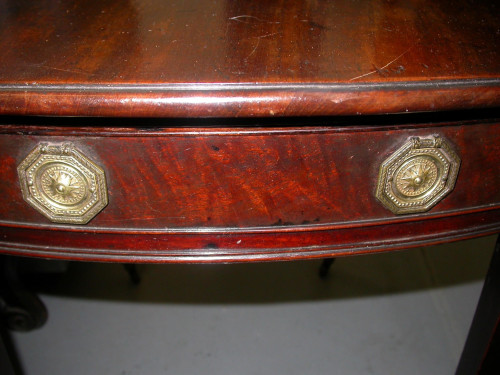
Mahogany pembroke table, with an oval top over a bowed frieze drawer raised on square tapered legs, with gaitered feet on brass socket castors. The top is made of solid mahogany constructed in three sections. The drawer has a mahogany front with cock beaded decoration (a type of semi-circular moulding which was applied to the edges of drawers) and is veneered with mahogany. The bottom, sides and back of the drawer are all made of oak.
The overall colour of the table is a deep rich dark mahogany. The top is pretty even in terms of colour and patina and the surface is old if not original with minor bruising and scratching and some stains. The underside of the top is heavily patinated and finger-marked around the edges. There is a pot mark on the centre top and the right hand leaf has kerf marks from a pit-saw. The frame and front of drawer have accretions of patinations around the handles and inside edges of the cock beading. The legs are dark, with oxidised patinated towards the top around the moulding and towards the feet.
The castors are original, dull, and unpolished with slight traces of the original lacquer. The handles, hinges and screws appear to original, and there are possible traces of lacquer or japanning on the hinges, which might have been used to prevent rusting. Two of the right hand hinges are lacking one screw, but there is no evidence the screw was ever fitted. All of the screws fixing the frame to the top appear to be original. However there is a unexplained screw hole in the underside of the top in the recess occupied by the fly leaf on each side. Both beech wood fly rails show considerable historic worm damage, which appears to have been treated.
The front sides and back of the drawer appear to be original. There are numerous ink smudges and splashes on all four surfaces, however these are not apparent on the drawer bottom. The bottom of the drawer has a curious greyish tone all over on the upper and lower surface. This could be woodworm treatment or it might indicate the bottom has been replaced using old timber.
The overall colour of the table is a deep rich dark mahogany. The top is pretty even in terms of colour and patina and the surface is old if not original with minor bruising and scratching and some stains. The underside of the top is heavily patinated and finger-marked around the edges. There is a pot mark on the centre top and the right hand leaf has kerf marks from a pit-saw. The frame and front of drawer have accretions of patinations around the handles and inside edges of the cock beading. The legs are dark, with oxidised patinated towards the top around the moulding and towards the feet.
The castors are original, dull, and unpolished with slight traces of the original lacquer. The handles, hinges and screws appear to original, and there are possible traces of lacquer or japanning on the hinges, which might have been used to prevent rusting. Two of the right hand hinges are lacking one screw, but there is no evidence the screw was ever fitted. All of the screws fixing the frame to the top appear to be original. However there is a unexplained screw hole in the underside of the top in the recess occupied by the fly leaf on each side. Both beech wood fly rails show considerable historic worm damage, which appears to have been treated.
The front sides and back of the drawer appear to be original. There are numerous ink smudges and splashes on all four surfaces, however these are not apparent on the drawer bottom. The bottom of the drawer has a curious greyish tone all over on the upper and lower surface. This could be woodworm treatment or it might indicate the bottom has been replaced using old timber.
Dimensions
Height: 73cm
Length: 91cm
Width: 74cm
Length: 91cm
Width: 74cm
Website keywords
tables
Label
Label text for 1790 Period Room (Room 4), Geffrye Museum, 2010:
Tables were kept folded away at the side of the room and brought out as needed. There was a greater variety of different types of table to choose from than previously. Both of those shown here were fairly new designs. They are lightweight and easy to move about the room. The card table folds away to a semi-circular form. The baize allowed playing cards to be picked up more easily. The table at the side of the room is a Pembroke. It was a versatile form that would have been used for taking tea and light meals.
Both mahogany, 1780s, replacement baize on card table
Label text for the exhibition At Home with the World, Geffrye Museum (20 March 2012- 9 September 2012):
Pembroke table
Mahogany
Made in England, about 1785
This table is influenced by designs from classical Greece and Rome. As well as being spread by people who had visited these ancient sites in person, neoclassical ideas were circulated using printed designs which could travel more quickly and cheaply, hand-to-hand. The table exhibits precise symmetry and delicate elegance in the tapered legs, and brass handles inspired by classical pavement design.
Tables were kept folded away at the side of the room and brought out as needed. There was a greater variety of different types of table to choose from than previously. Both of those shown here were fairly new designs. They are lightweight and easy to move about the room. The card table folds away to a semi-circular form. The baize allowed playing cards to be picked up more easily. The table at the side of the room is a Pembroke. It was a versatile form that would have been used for taking tea and light meals.
Both mahogany, 1780s, replacement baize on card table
Label text for the exhibition At Home with the World, Geffrye Museum (20 March 2012- 9 September 2012):
Pembroke table
Mahogany
Made in England, about 1785
This table is influenced by designs from classical Greece and Rome. As well as being spread by people who had visited these ancient sites in person, neoclassical ideas were circulated using printed designs which could travel more quickly and cheaply, hand-to-hand. The table exhibits precise symmetry and delicate elegance in the tapered legs, and brass handles inspired by classical pavement design.
-
© Museum of the Home, London
-
© Museum of the Home, London
-
-
-