
14/2006
Collection
Furniture
Brief description
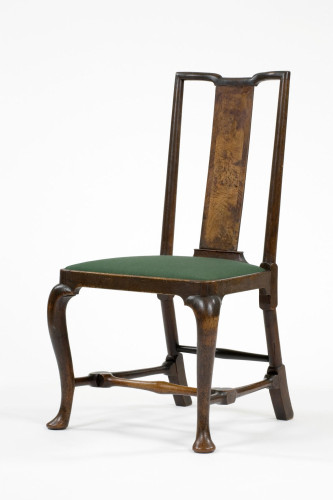
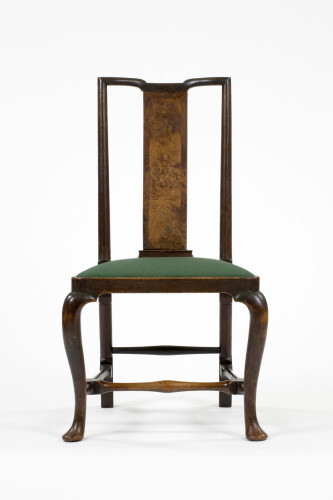
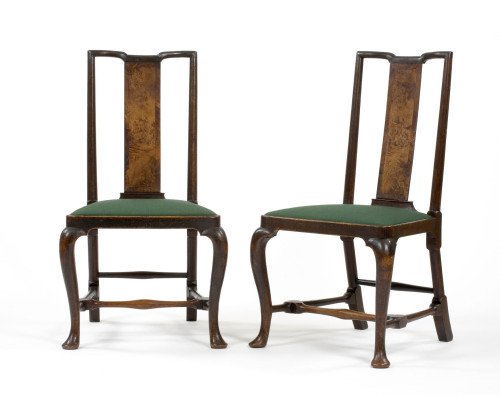
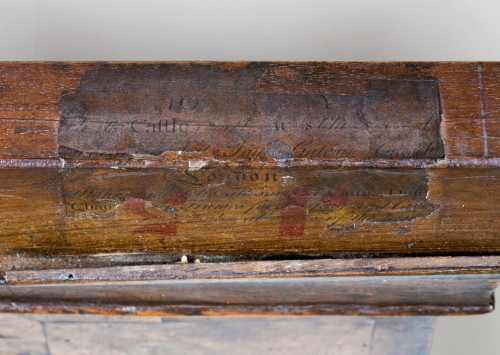
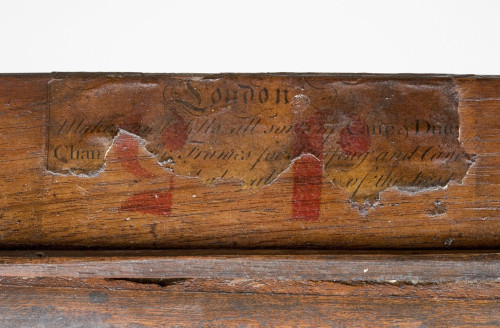
Walnut India-back chair, the remains of a trade label of William Old and John Ody, chair makers and retailers of St Paul's Churchyard in the City of London glued to the inside back seat rail, one of a pair, c. 1725.
Object name
chair
Object number
14/2006
Production organisation
William Old and John Ody (manufacturer and/or retailer)
Production date
c.1725 (manufactured)
Production place
London (manufactured)
Period
Georgian (1714-1837)
Material
walnut
wool
beech
walnut veneer
varnish
wool
beech
walnut veneer
varnish
Technique
joined
carved
turned
hand written
inscribed
stamped
stencilled
veneered
tenoned
glued
nailed
pegged
applied
varnished
carved
turned
hand written
inscribed
stamped
stencilled
veneered
tenoned
glued
nailed
pegged
applied
varnished
Physical description
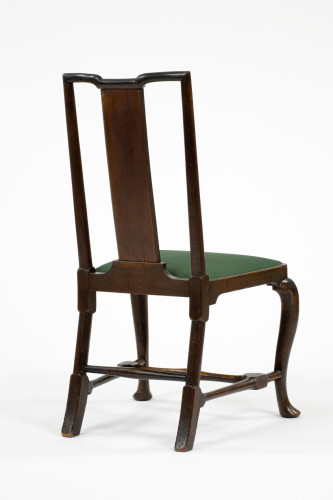
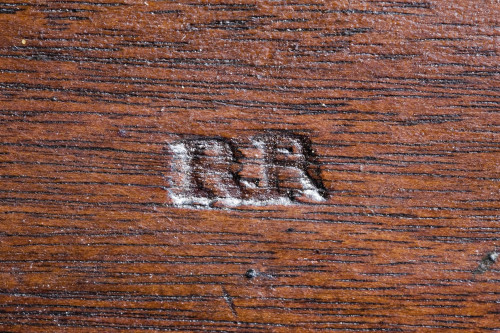
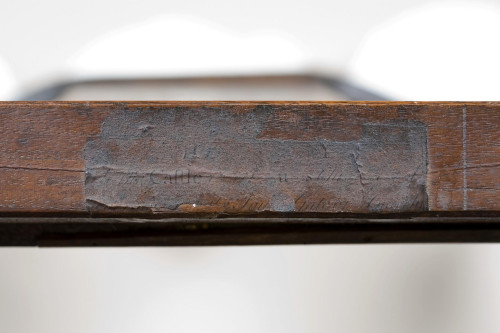
Walnut chair, with a yolk top rail over a rectangular splat between turned posts. The drop-in seat is raised on cabriole legs with turned stretchers. The inside back rail has the remains of the trade label of William Old and John Ody, pasted upside down. Over this is superimposed a red stencilled mark 'J5', and to the left is inscribed ‘3’ in blunt pencil with a circle round it. The rebate on the front rail is marked III (3 in Roman numerals) and the back rail is stamped ‘RR’.
The chair is made from solid walnut, except for the splat which is walnut veneered onto beechwood. The top rail is morticed onto the back posts. The splat is veneered with figured walnut, cross-banded with walnut, and tenoned up into the top rail and into the shoe. This is framed with a band of figured walnut. The shoe is glued directly down onto the rear seat rail. The rails are tenoned into the legs and are rebated to accept the drop-in seat. All the joints are pegged with a single peg. There are supporting blocks nailed to the rails at the joint with the back posts. The shaped brackets at the tops of the legs are thicknessed with glued additions. The exposed endgrain on the tops of the legs is concealed with an applied facing of walnut, which extends across the joint on the front and side rails. The stretchers are tenoned all round, except the back stretcher which is doweled.
The whole chair is covered in a thick semi-opaque brown varnish, which is not original. It is heavily patinated in places with ecretions of dirt and wax. It is relatively lightly patinated in areas of high wear, such as the splat, seat rails and stretchers. The beechwood splat has an old worm infestation, and a slight loss to the top right corner. There is a small chip to the left upper side of the shoe and to the leading edge of the shoe. The supporting blocks at the back of the seat rails appear to be original, with original nails. There is a repaired break to the top of the right leg at the joint with the rails. There is considerable bruising to the legs, feet and stretchers. All the pegs appear to be original, except the one at the front right. Both feet have been repaired.
The chair is made from solid walnut, except for the splat which is walnut veneered onto beechwood. The top rail is morticed onto the back posts. The splat is veneered with figured walnut, cross-banded with walnut, and tenoned up into the top rail and into the shoe. This is framed with a band of figured walnut. The shoe is glued directly down onto the rear seat rail. The rails are tenoned into the legs and are rebated to accept the drop-in seat. All the joints are pegged with a single peg. There are supporting blocks nailed to the rails at the joint with the back posts. The shaped brackets at the tops of the legs are thicknessed with glued additions. The exposed endgrain on the tops of the legs is concealed with an applied facing of walnut, which extends across the joint on the front and side rails. The stretchers are tenoned all round, except the back stretcher which is doweled.
The whole chair is covered in a thick semi-opaque brown varnish, which is not original. It is heavily patinated in places with ecretions of dirt and wax. It is relatively lightly patinated in areas of high wear, such as the splat, seat rails and stretchers. The beechwood splat has an old worm infestation, and a slight loss to the top right corner. There is a small chip to the left upper side of the shoe and to the leading edge of the shoe. The supporting blocks at the back of the seat rails appear to be original, with original nails. There is a repaired break to the top of the right leg at the joint with the rails. There is considerable bruising to the legs, feet and stretchers. All the pegs appear to be original, except the one at the front right. Both feet have been repaired.
Dimensions
Depth: 58cm
Height: 101.5cm
Width: 56cm
Height: 101.5cm
Width: 56cm
Website keywords
seating
Label
Label text for the exhibition At Home with the World, Geffrye Museum (20 March 2012- 9 September 2012):
Chair
Made by William Old and John Ody, London, England
Walnut frame with reproduction drop-in seat, about 1725
Having a chair back formed from a ‘splat’ running vertically from seat to rail was a Chinese innovation. These chairs were initially described in England as ‘Indian’ or ‘India-back’ as seen on the illustrated trade card. ‘India’ was a catch-all term referring to anything relating to Asian countries. The design is actually a fusion of Chinese and French; the double-curved legs originating in France.
Purchased with the assistance of the Art Fund, the MLA/V&A Purchase Grant Fund and the Friends of the Geffrye Museum
Chair
Made by William Old and John Ody, London, England
Walnut frame with reproduction drop-in seat, about 1725
Having a chair back formed from a ‘splat’ running vertically from seat to rail was a Chinese innovation. These chairs were initially described in England as ‘Indian’ or ‘India-back’ as seen on the illustrated trade card. ‘India’ was a catch-all term referring to anything relating to Asian countries. The design is actually a fusion of Chinese and French; the double-curved legs originating in France.
Purchased with the assistance of the Art Fund, the MLA/V&A Purchase Grant Fund and the Friends of the Geffrye Museum
-
© Museum of the Home, London
-
© Museum of the Home, London
-
© Museum of the Home, London
-
© Museum of the Home, London
-
© Museum of the Home, London
-
© Museum of the Home, London
-
© Museum of the Home, London
-
© Museum of the Home, London


