13/2006-1
Collection
Furniture
Brief description
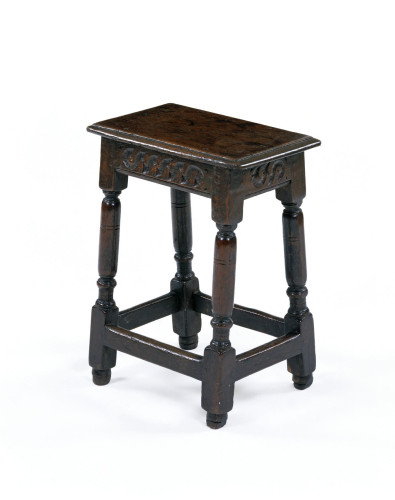
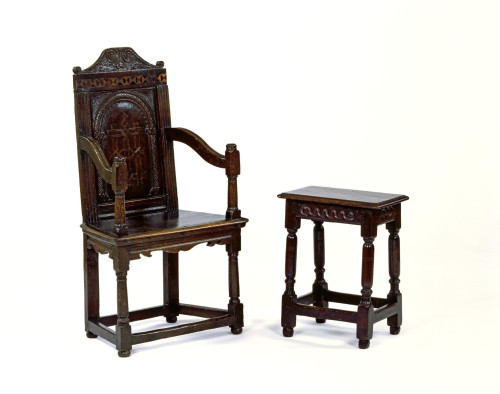
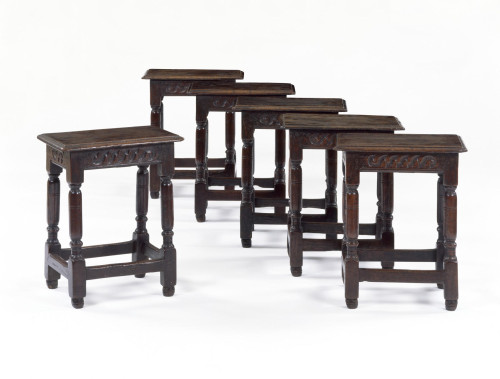
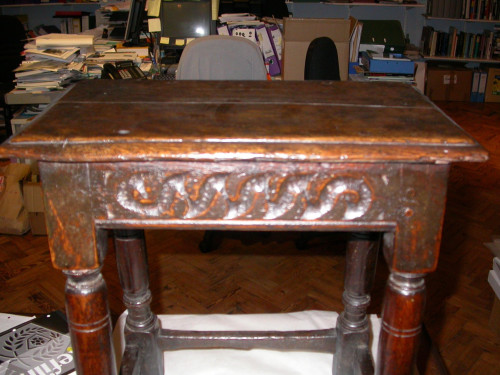
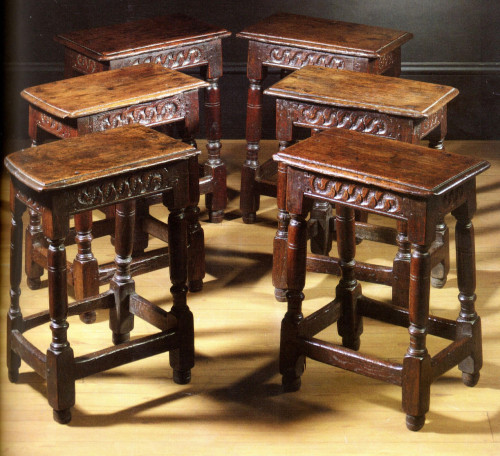
One of six matching oak joined stools with a carved frieze and turned decoration, made in England, c.1600-1650.
Object name
stool
joined stool
joined stool
Object number
13/2006-1
Location
On Display
Production date
c.1600-1650 (manufactured)
Production place
England (manufactured)
Period
Stuart (1603-1714)
Material
oak
Technique
joined
turned
carved
turned
carved
Physical description
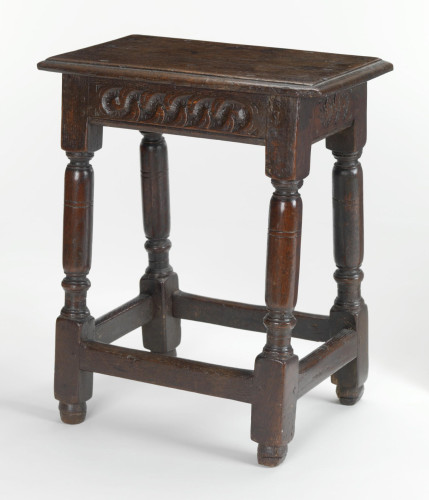
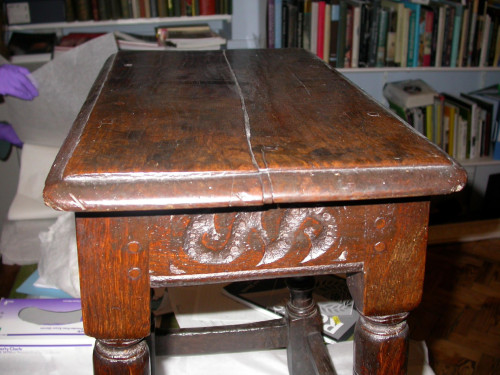
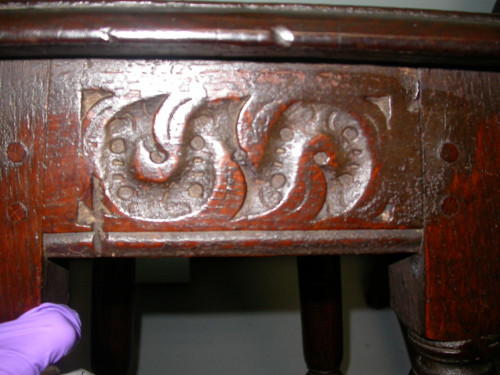
Joined oak stool, with a rectangular top and ovolo-moulded (convex moulded) edge over guilloche-carved rails (carved with a repetitive architectural pattern of two ribbons winding around a series of regular central points), on swelled-pillar legs, joined by a plain peripheral stretcher and ball feet. The stool has a moulded seat and there is an inscribed brass plaque pinned to the underside of one rail which dates from the 1920s.
The stool is constructed as an open tenoned frame with a moulded seat. The stool has a deep brown colour throughout, with heavy patination in places not exposed to wear. There are extensive traces of old finishes, both varnish and paint and the underside of the top and insides of the rails are covered with a thin ochre wash.
There are chips and wear to the edges of the top and the legs have flats worn on them on the outside faces, presumably as a result of being slid onto the stretcher rails of a dining table when not in use. The outer edges of all four feet are heavily chamfered for similar reasons and there is slight rot/worm damage to the feet.
The stool is constructed as an open tenoned frame with a moulded seat. The stool has a deep brown colour throughout, with heavy patination in places not exposed to wear. There are extensive traces of old finishes, both varnish and paint and the underside of the top and insides of the rails are covered with a thin ochre wash.
There are chips and wear to the edges of the top and the legs have flats worn on them on the outside faces, presumably as a result of being slid onto the stretcher rails of a dining table when not in use. The outer edges of all four feet are heavily chamfered for similar reasons and there is slight rot/worm damage to the feet.
Dimensions
Height: 57.5cm
Width: 48cm
Depth: 32cm
Width: 48cm
Depth: 32cm
Website keywords
seating
Label
Label text for 1630 Period Room (Room 1), Geffrye Museum, 2010:
Draw-leaf table and stools
A draw-leaf table combined with a set of stools was a standard part of the furnishings of the hall for nearly a hundred years, from at least 1580 to 1660. The table would have been the main surface for many of the household’s activities, where people sat down to read, write, sew and eat dinner, and play games such as backgammon. The ‘draw-leaves’ sit underneath the main part of the tabletop and can be pulled out to extend it.
Table, oak, c1620; stools, oak, c1600.
Draw-leaf table and stools
A draw-leaf table combined with a set of stools was a standard part of the furnishings of the hall for nearly a hundred years, from at least 1580 to 1660. The table would have been the main surface for many of the household’s activities, where people sat down to read, write, sew and eat dinner, and play games such as backgammon. The ‘draw-leaves’ sit underneath the main part of the tabletop and can be pulled out to extend it.
Table, oak, c1620; stools, oak, c1600.
-
© Museum of the Home, London
-
© Museum of the Home, London
-
© Museum of the Home, London
-
-
-
-
-