273/1998
Collection
Furniture
Brief description
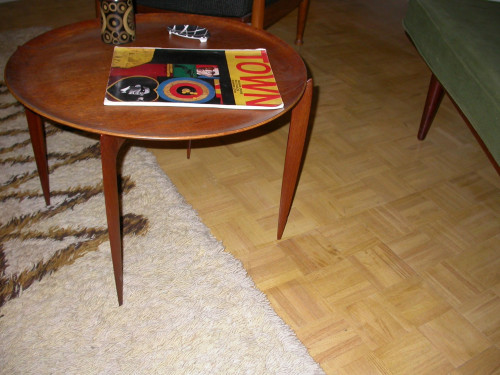
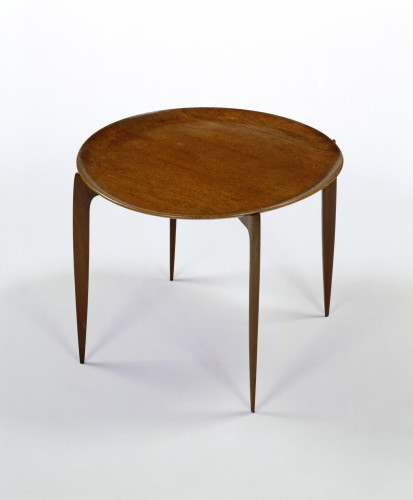
Coffee table with a removable top which also functions as a tray, made from plywood with a teak veneer and a solid teak frame. It was manufactured by Fritz Hansen Ltd., in Denmark in c. 1958 and was retailed through Heal's in London. This table was acquired from the original owner.
Object name
table
Object number
273/1998
Production organisation
Fritz Hansen Ltd (manufacturer)
Heal and Son Ltd (retailer)
Heal and Son Ltd (retailer)
Production date
c.1958 (manufactured)
Production place
Denmark (manufactured)
London (retailed)
London (retailed)
Period
Twentieth century (1900-1999)
Material
plywood
teak
teak
Technique
veneered
Physical description
Coffee table with a removable top, made from ply faced with teak, on a teak frame.
Dimensions
Diameter: 59.5cm
Website keywords
living room furniture
tables
tables
Label
Caption for Exploring 20th Century London website:
This table was originally owned by a family who lived in Kilburn, north London. They lived in a mid-nineteenth century semi-detached suburban villa and used this table in the living room. They decorated the room with a mixture of contemporary furniture and antiques. They purchased it when it was new from Heal's on Tottenham Court Road. The tabletop and legs are separate, so that the top may be used as a tray. At the time when they bought it, it had been stored in damp conditions so the top was slightly warped. Because of that, they were able to buy it for £15, which was about a third of its original price. It was made in Denmark and Scandinavian designs like this one were very popular in the 1960s.
Label text for the exhibition At Home with the World, Geffrye Museum (20 March 2012- 9 September 2012):
Coffee table
Teak veneer and solid teak
Manufactured by Fritz Hansen Ltd., Denmark and retailed by Heal’s, London, England, 1958
Although modernism began in the 1930s, it did not have time to get established in the English home until after the Second World War. This table is Scandinavian Modernism of the 1950s, and what sets it apart from its forerunners is the prominence given to the natural materials used to make it.
This object was featured in the World at Home project and display at the Geffrye Museum from 17 May to 24 July 2011. The project was a result of a collaboration between the Geffrye Museum and MA students from the Institute of Archeology, University College London. The students chose eleven objects from the museum’s period rooms to highlight the narrative of England’s ever-changing relationship with the rest of the world. Through the expansion of the British Empire and development of international trade, the English middle classes brought into their homes goods as varied as pottery from Germany, tea from China and modern furniture from Scandinavia. Other outputs of the project included design marketing materials, on-line activities, events, design activities for children and visitor and audience research.
The students researched these objects and prepared text panels for the display. The text is recorded below:
Northern Lights
English middle-class homes in the 1950s and 1960s could be furnished with Scandinavian design. Danish modern was a particularly appealing style, valued for its elegant forms, everyday functionality, and quality craftsmanship.
The New Look From Scandinavia
Wartime conditions badly affected English industry. Furniture was therefore rationed under the Utility scheme during and after the war. When the restrictions ended, people craved new designs. The Festival of Britain in 1951 paved the way for the modern style. Soon, furniture companies like Heal’s and Finmar started importing Danish modern furniture. Scandinavian design influenced people’s taste and inspired English craftsmen and manufacturers.
Traditional Craftsmanship for Modern Homes
The slender wooden forms of Scandinavian furniture attracted those who valued good design and use of high-quality natural materials. As English middle-class homes became smaller in size, open-plan interiors were introduced, calling for flexible, less bulky furniture that would take up less space. A low table like this provided a surface for magazines, drinks and snacks, without blocking the view to the television. Being stylish and functional at the same time, it suited the informal family lifestyle that was developing in England.
Danish modern furniture was comfortable and practical. This coffee table folds flat to take up less space, while its top can be used as a tray. It would have been brought as a tray to the kitchen, laden with snacks, and then brought back to the living room, travelling seamlessly through the house.
As English middle-class families no longer employed servants, women were responsible for looking after children and running the household. Interior design had to adapt to the changes in family life. The kitchen was positioned close to the living room to facilitate the supervision of children. Living spaces became more flexible, with open-plan areas that served both as living and dining rooms. This layout required flexible furniture that would be easily movable and multifunctional.
Import companies like Finmar Ltd, and department stores like Heal’s and Harrods introduced Scandinavian design to the English middle-class. Finmar, in particular, specialised in Scandinavian Design, and largely dominated the English market in this area. It promoted its stock as ‘The best from Scandinavia’, enhancing the impression of Scandinavia as a cultural unit with specific design.
Label text for a touchscreen computer programme displayed in the exhibition At Home with the World, Geffrye Museum (20 March 2012- 9 September 2012):
Introduction
This versatile table comes apart into two sections; the round top can be used as a tray and the lightweight legs can be folded away for handy storage. It was made in Denmark and is characteristic of the simple yet functional design and minimal use of natural materials used in Scandinavian furniture in the 1950s. [This information was displayed alongside a photograph of this table, (object number 273/1998-1 and -2), caption 'Coffee table, plywood and solid teak, by Fritz Hansen Ltd., Denmark, 1958.']
Global Connections, Scandinavia, Denmark:
During World War II the British furniture industry was devastated. In the years which followed, the government promoted their idea of ‘good design’ which was characterised by Danish furniture like this and encouraged its importation. [This information was displayed alongside a photograph of this table on display in the 1960s room at the Geffrye Museum, caption 'Coffee table on display in 1965 living room at the Geffrye.']
Who owned it?
Although a table like this was affordable to the middle classes, it does not represent mainstream taste in the 1950s and 60s. It would have appealed to people with an interest in ‘good design’. In these photographs a similar table is in use in a home in Highgate, north London in the late 1950s. [This information was displayed alongside a photograph of a table of this design in a living room in Highgate, from Documenting Homes Collection (object number 185/2012-6).']
Fritz Hansen
Fritz Hansen, the company which manufactured this table, worked with several influential twentieth-century furniture designers. Arne Jacobsen’s Series 7 chair, designed in 1955, and Piet Hein’s Superellipse table, designed in 1968, were made by the company and are still in production today. [This information was displayed alongside two alternative photographs, one of a stack of Arne Jacobsen Series 7 chairs in the Geffrye Museum collection (object numbers 226/2003-1 to 226/2003-6) and one of a Superelipse table made by Fritz Hansen in the Geffrye Museum collection (object number 225/2003), captions 'Series 7 chairs, by Arne Jacobsen, made by Fritz Hansen Ltd., c.1991' and 'Superellipse table, by Piet Hein, made by Fritz Hansen Ltd., Denmark, 1991.']
A full transcript of this information and associated images is available on the object history file.
This table was originally owned by a family who lived in Kilburn, north London. They lived in a mid-nineteenth century semi-detached suburban villa and used this table in the living room. They decorated the room with a mixture of contemporary furniture and antiques. They purchased it when it was new from Heal's on Tottenham Court Road. The tabletop and legs are separate, so that the top may be used as a tray. At the time when they bought it, it had been stored in damp conditions so the top was slightly warped. Because of that, they were able to buy it for £15, which was about a third of its original price. It was made in Denmark and Scandinavian designs like this one were very popular in the 1960s.
Label text for the exhibition At Home with the World, Geffrye Museum (20 March 2012- 9 September 2012):
Coffee table
Teak veneer and solid teak
Manufactured by Fritz Hansen Ltd., Denmark and retailed by Heal’s, London, England, 1958
Although modernism began in the 1930s, it did not have time to get established in the English home until after the Second World War. This table is Scandinavian Modernism of the 1950s, and what sets it apart from its forerunners is the prominence given to the natural materials used to make it.
This object was featured in the World at Home project and display at the Geffrye Museum from 17 May to 24 July 2011. The project was a result of a collaboration between the Geffrye Museum and MA students from the Institute of Archeology, University College London. The students chose eleven objects from the museum’s period rooms to highlight the narrative of England’s ever-changing relationship with the rest of the world. Through the expansion of the British Empire and development of international trade, the English middle classes brought into their homes goods as varied as pottery from Germany, tea from China and modern furniture from Scandinavia. Other outputs of the project included design marketing materials, on-line activities, events, design activities for children and visitor and audience research.
The students researched these objects and prepared text panels for the display. The text is recorded below:
Northern Lights
English middle-class homes in the 1950s and 1960s could be furnished with Scandinavian design. Danish modern was a particularly appealing style, valued for its elegant forms, everyday functionality, and quality craftsmanship.
The New Look From Scandinavia
Wartime conditions badly affected English industry. Furniture was therefore rationed under the Utility scheme during and after the war. When the restrictions ended, people craved new designs. The Festival of Britain in 1951 paved the way for the modern style. Soon, furniture companies like Heal’s and Finmar started importing Danish modern furniture. Scandinavian design influenced people’s taste and inspired English craftsmen and manufacturers.
Traditional Craftsmanship for Modern Homes
The slender wooden forms of Scandinavian furniture attracted those who valued good design and use of high-quality natural materials. As English middle-class homes became smaller in size, open-plan interiors were introduced, calling for flexible, less bulky furniture that would take up less space. A low table like this provided a surface for magazines, drinks and snacks, without blocking the view to the television. Being stylish and functional at the same time, it suited the informal family lifestyle that was developing in England.
Danish modern furniture was comfortable and practical. This coffee table folds flat to take up less space, while its top can be used as a tray. It would have been brought as a tray to the kitchen, laden with snacks, and then brought back to the living room, travelling seamlessly through the house.
As English middle-class families no longer employed servants, women were responsible for looking after children and running the household. Interior design had to adapt to the changes in family life. The kitchen was positioned close to the living room to facilitate the supervision of children. Living spaces became more flexible, with open-plan areas that served both as living and dining rooms. This layout required flexible furniture that would be easily movable and multifunctional.
Import companies like Finmar Ltd, and department stores like Heal’s and Harrods introduced Scandinavian design to the English middle-class. Finmar, in particular, specialised in Scandinavian Design, and largely dominated the English market in this area. It promoted its stock as ‘The best from Scandinavia’, enhancing the impression of Scandinavia as a cultural unit with specific design.
Label text for a touchscreen computer programme displayed in the exhibition At Home with the World, Geffrye Museum (20 March 2012- 9 September 2012):
Introduction
This versatile table comes apart into two sections; the round top can be used as a tray and the lightweight legs can be folded away for handy storage. It was made in Denmark and is characteristic of the simple yet functional design and minimal use of natural materials used in Scandinavian furniture in the 1950s. [This information was displayed alongside a photograph of this table, (object number 273/1998-1 and -2), caption 'Coffee table, plywood and solid teak, by Fritz Hansen Ltd., Denmark, 1958.']
Global Connections, Scandinavia, Denmark:
During World War II the British furniture industry was devastated. In the years which followed, the government promoted their idea of ‘good design’ which was characterised by Danish furniture like this and encouraged its importation. [This information was displayed alongside a photograph of this table on display in the 1960s room at the Geffrye Museum, caption 'Coffee table on display in 1965 living room at the Geffrye.']
Who owned it?
Although a table like this was affordable to the middle classes, it does not represent mainstream taste in the 1950s and 60s. It would have appealed to people with an interest in ‘good design’. In these photographs a similar table is in use in a home in Highgate, north London in the late 1950s. [This information was displayed alongside a photograph of a table of this design in a living room in Highgate, from Documenting Homes Collection (object number 185/2012-6).']
Fritz Hansen
Fritz Hansen, the company which manufactured this table, worked with several influential twentieth-century furniture designers. Arne Jacobsen’s Series 7 chair, designed in 1955, and Piet Hein’s Superellipse table, designed in 1968, were made by the company and are still in production today. [This information was displayed alongside two alternative photographs, one of a stack of Arne Jacobsen Series 7 chairs in the Geffrye Museum collection (object numbers 226/2003-1 to 226/2003-6) and one of a Superelipse table made by Fritz Hansen in the Geffrye Museum collection (object number 225/2003), captions 'Series 7 chairs, by Arne Jacobsen, made by Fritz Hansen Ltd., c.1991' and 'Superellipse table, by Piet Hein, made by Fritz Hansen Ltd., Denmark, 1991.']
A full transcript of this information and associated images is available on the object history file.
-
© Museum of the Home, London
-