41/1997
Collection
Furniture
Brief description
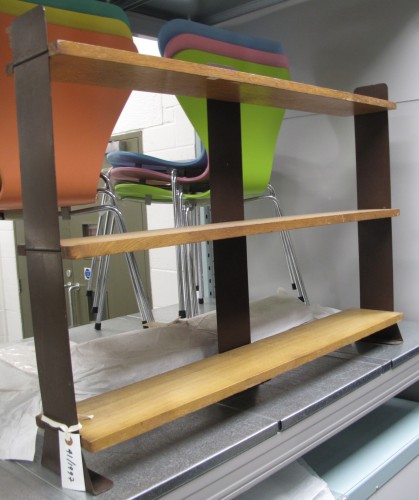
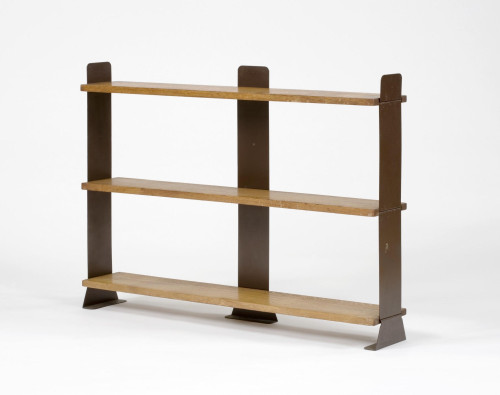
Three-tiered bookshelf made from oak with three metal supports, designed by Wilhelm Kienzle in 1930 and distributed in the United Kingdom by Isokon from 1934 to 1938.
Object name
bookshelf
Object number
41/1997
Production person
Kienzle, Wilhelm (designer)
Production organisation
Isokon (distributor)
Production date
1930 (designed)
1936 (manufactured)
1936 (manufactured)
Production place
Switzerland (designed)
England (retailed)
England (retailed)
Period
Twentieth century (1900-1999)
Material
oak
metal
metal
Technique
polished
bent
bent
Physical description
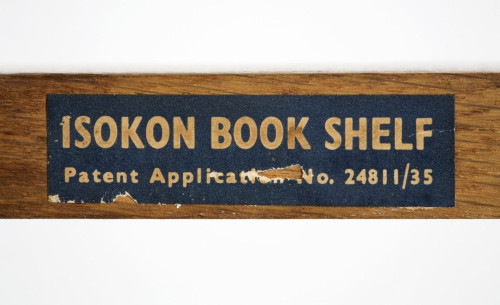
This set of shelves is composed of three horizontal oak shelves supported by three flat metal supports, one at each end and one in the middle at the back. The supports are formed from four sections of bent metal painted brown, the ends of which are inserted into slots in the wooden shelves. There are three blue and white labels on the back of the wooden shelves printed with ‘Isokon Bookshelf Patent Application No 24811/35’. The label on the top shelf is partially lost. There are two 'coffee rings' on the top shelf and some water damage to the top and middle shelves.
Dimensions
Height: 66cm
Width: 92.2cm
Depth: 15.3cm
Width: 92.2cm
Depth: 15.3cm
Website keywords
Decoration and furnishings
furniture
furniture
Label
Caption for Exploring 20th Century London website:
A Swiss designer, Kienzle, designed this oak bookshelf with metal supports in 1934 and a set was bought by Jack and Molly Pritchard, of Isokon. They acquired patent rights and it was the first piece of furniture their London firm distributed. It was sold flat-pack, intended to be assembled at home, and it was aimed at the same sort of consumer their Lawn Road 'minimum' flats were designed for: people living 'mobile' lives in small spaces with built-in or portable furniture.
A Swiss designer, Kienzle, designed this oak bookshelf with metal supports in 1934 and a set was bought by Jack and Molly Pritchard, of Isokon. They acquired patent rights and it was the first piece of furniture their London firm distributed. It was sold flat-pack, intended to be assembled at home, and it was aimed at the same sort of consumer their Lawn Road 'minimum' flats were designed for: people living 'mobile' lives in small spaces with built-in or portable furniture.
-
© Museum of the Home, London
-
© Museum of the Home, London
-