20/1997
Collection
Metalwork
Brief description
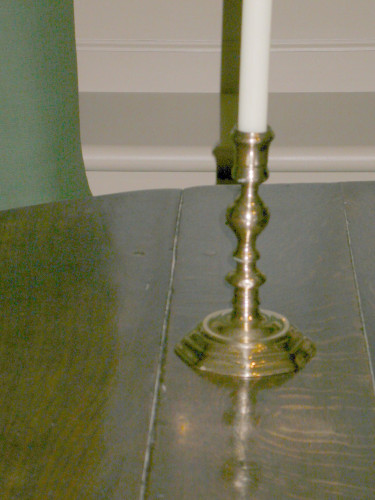
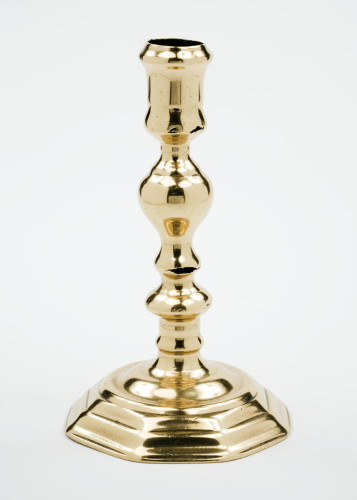
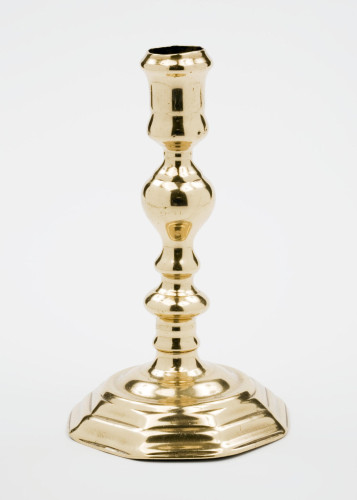
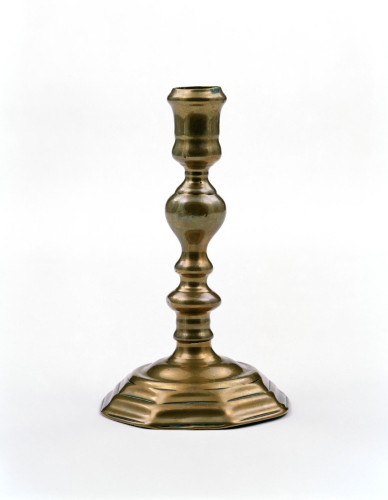
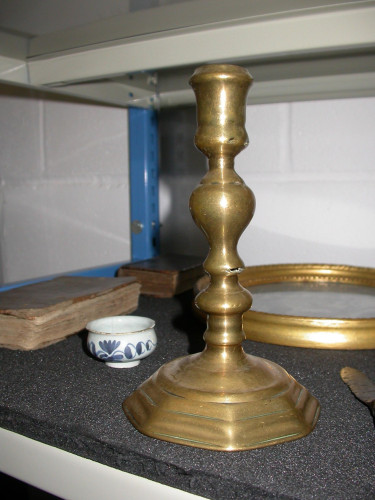
Candlestick with a stepped octagonal base, baluster stem and knops towards the bottom, and a split at the base of the nozzle, cast in brass and made in England c.1715.
Object name
candlestick
Object number
20/1997
Production date
c.1715 (manufactured)
Production place
England (manufactured)
Period
Stuart (1603-1714)
Georgian (1714-1837)
Georgian (1714-1837)
Material
brass
Technique
sand cast
turned
brazed
turned
brazed
Physical description
This brass candlestick has a stepped octagonal base, with a baluster stem composed of an upper slightly elongated spherical knop, above two more flange-shaped knops, the middle one with a split. The vertical seam (the join from casting) is visible, just opening up slightly towards the base. The top baluster looks round but feeling it shows that it is faceted, which indicates, according to Roderick Butler, that it has been worn (probably through cleaning) over time. Originally this baluster would have matched the octagonal base. The base of the candlestick looks thoroughly old with signs of wear; it has not been disturbed or polished. There are some holes in thin parts of the casting. There are no signs of repair.
Dimensions
Height: 18.5cm
Diameter: 11cm
Diameter: 11cm
Website keywords
candle and rush lighting
Label
Label text, Geffrye Museum, date unknown:
Brass candlestick, c. 1700-1710.
Label text for 'Lighting the home' case, Information Bay 5, Geffrye Museum, 2010:
Candlestick, 1700–1710
Brass
The baluster candlestick was an enduring type; although there were variations in style as fashions changed, candlesticks not too different from this one were used in middling households right up to the end of the nineteenth century.
Brass candlestick, c. 1700-1710.
Label text for 'Lighting the home' case, Information Bay 5, Geffrye Museum, 2010:
Candlestick, 1700–1710
Brass
The baluster candlestick was an enduring type; although there were variations in style as fashions changed, candlesticks not too different from this one were used in middling households right up to the end of the nineteenth century.
-
© Museum of the Home, London
-
© Museum of the Home, London
-
© Museum of the Home, London
-
-