2/1996
Collection
Furniture
Brief description
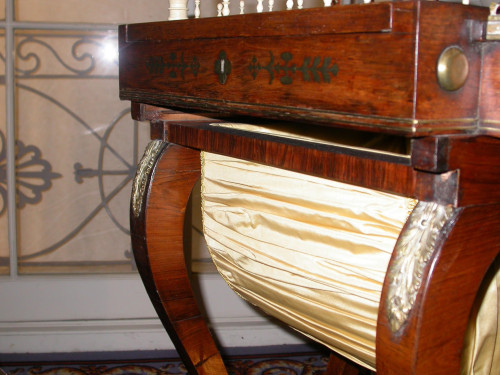
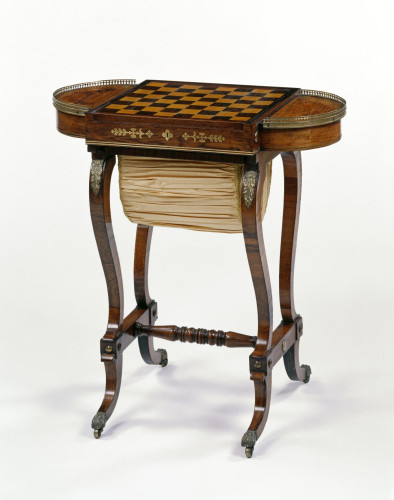
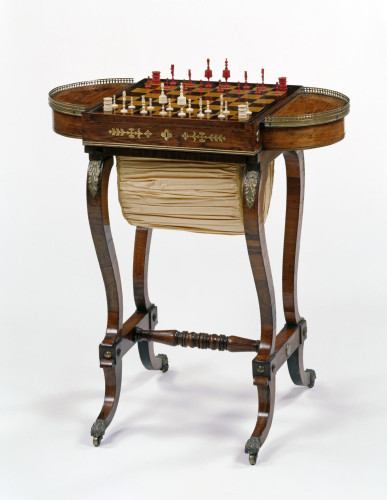
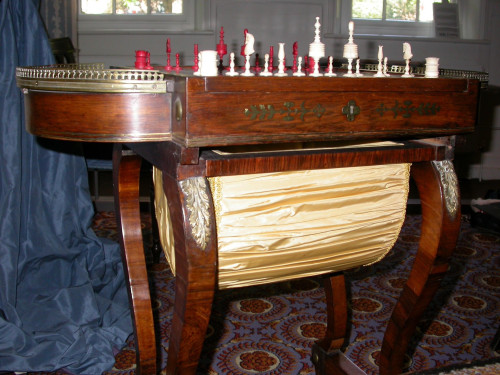
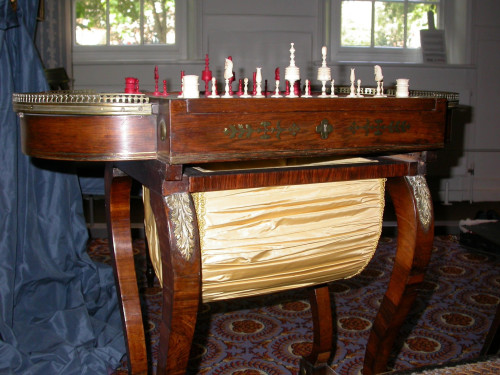
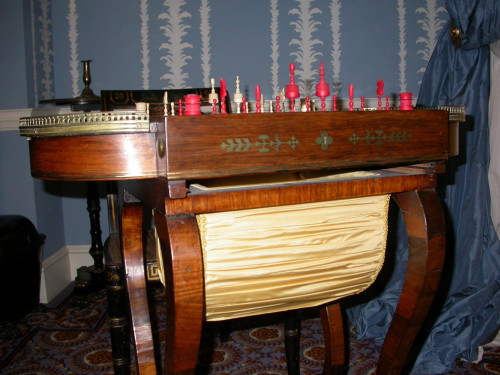
Reading, games and needlework table made from rosewood veneered mahogany, with brass inlay and mounts, a painted leather backgammon board, and a modern silk needlework bag, probably manufactured in England, c.1815.
Object name
games table
Object number
2/1996
Production date
c.1815 (manufactured)
Production place
England (manufactured)
Period
Georgian (1714-1837)
Material
mahogany
brass
leather
silk
rosewood veneer
holly
ebony
deal
brass
leather
silk
rosewood veneer
holly
ebony
deal
Technique
joined
veneered
cast
painted
inlaid
turned
veneered
cast
painted
inlaid
turned
Physical description
Combined rosewood games and work table with a hinged adjustable and removable book rest. Below the book rest there is a well with a painted leather backgammon board, under which there is a sliding chess/chequers board, veneered in holly ans possibly ebony which replaces the reading slope. Beneath this is a sliding needlework bag, made of pleated yellow silk, in the form of a gathered silk drum, which is a replica. At the side of the table there are two semi-circular compartments with hinged lids, brass galleries and fitted interiors. The top is raised on lyre-shaped supports on trestle bases joined by a turned stretcher and it stands on sabre feet with brass paw caps and casters. The whole is in rosewood veneer on a mahogany carcase.
The table has numerous patched repairs to veneers all over the table and there are patches of later varnish. The chess board has a slight warp making its action very stiff and there is a split in the substrate which shows through the veneered upper surface. The chess squares themselves are cracked and are lifting in numerous places. There is a split in the deal substrate of the main compartment which shows through to the leather of the backgammon board.
The half round side compartments have shrunk across their width. There is also damage to the veneers where the brass gallery is screwed at either end and the gallery has been re-fixed in places with modern screws. The hinge is also re-fixed with modern screws. The left hand compartment is missing a tray insert. There are some splits to the veneers on the interior of the left compartment. The large screws securing the main carcase to the batons have been moved and re-inserted. The base of the main carcase and the side compartments have been covered with a black wash. The brass mounts to the rear top of legs are missing on both sides. The tips of the lyre legs have been replaced and there is a patch of veneer missing on the left rear leg. The castors appear to be original but they have been removed and put back at some point. The screws are a mixture of new and old. The underside of the legs and the trestles are painted with a black wash.
The table has numerous patched repairs to veneers all over the table and there are patches of later varnish. The chess board has a slight warp making its action very stiff and there is a split in the substrate which shows through the veneered upper surface. The chess squares themselves are cracked and are lifting in numerous places. There is a split in the deal substrate of the main compartment which shows through to the leather of the backgammon board.
The half round side compartments have shrunk across their width. There is also damage to the veneers where the brass gallery is screwed at either end and the gallery has been re-fixed in places with modern screws. The hinge is also re-fixed with modern screws. The left hand compartment is missing a tray insert. There are some splits to the veneers on the interior of the left compartment. The large screws securing the main carcase to the batons have been moved and re-inserted. The base of the main carcase and the side compartments have been covered with a black wash. The brass mounts to the rear top of legs are missing on both sides. The tips of the lyre legs have been replaced and there is a patch of veneer missing on the left rear leg. The castors appear to be original but they have been removed and put back at some point. The screws are a mixture of new and old. The underside of the legs and the trestles are painted with a black wash.
Dimensions
Height: 75.1cm
Width: 73.5cm
Depth: 49.8cm
Width: 73.5cm
Depth: 49.8cm
Website keywords
tables
games
reading
needlework
games
reading
needlework
Label
Label text, Geffrye Museum, date unknown:
Combined games and needlework table, rosewood veneer on a mahogany carcase, with brass mounts and inlay, with reading slope, sliding needlework bag, chess and backgammon boards, c1815.
Label text for 1830 Period Room (Room 5), Geffrye Museum, 2010:
Needlework and games table
This small table has a deep drawer for needlework, and a reversible top with inlaid woods forming backgammon and chess boards. The legs are in the form of lyres, a type of stringed musical instrument and a popular classical motif. This decorative piece of furniture is typical of the period, when the demand for novelty and fashion at affordable rates was being met by a growing manufacturing industry.
Veneered in rosewood, with brass mounts, c1815
Label text for the exhibition At Home with the World, Geffrye Museum (20 March 2012- 9 September 2012):
Chess pieces
These bone chess pieces were probably made in England, and imitate Indian stained ivory ones. Chess originated as a game of strategy in India in the 6th century, and reached Western Europe by the 10th. Adaptations were made to the game in Europe, including introducing the queen as the most powerful piece.
This object was featured in the World at Home project and display at the Geffrye Museum from 17 May to 24 July 2011. The project was a result of a collaboration between the Geffrye Museum and MA students from the Institute of Archeology, University College London. The students chose eleven objects from the museum’s period rooms to highlight the narrative of England’s ever-changing relationship with the rest of the world. Through the expansion of the British Empire and development of international trade, the English middle classes brought into their homes goods as varied as pottery from Germany, tea from China and modern furniture from Scandinavia. Other outputs of the project included design marketing materials, on-line activities, events, design activities for children and visitor and audience research.
The students researched these objects and prepared text panels for the display. The text is recorded below:
Past Meets Present
Excavation of archaeological ruins such as Herculaneum and Pompeii ignited the public’s fascination with the ancient world in the eighteenth century. Greco-Roman artifacts inspired English designers, architects and artisans.The new understanding of the classical world had a great impact on the design of decorative furnishings. For example, the curved legs of this games table imitate the shape of a lyre, a musical instrument of ancient Greece.
A Grand Design
Opportunities for the middle classes to embark on a Grand Tour, a costly trip through Europe to enjoy its cultural legacy and polite society, were still rare in the early 1800s. Nonetheless a fascination with the classical world led to a demand for objects reflecting this. English designers and manufacturers produced furniture and decorative objects in the neoclassical style at affordable prices to meet this new demand.
Functional Elegance
A multifunctional games and work table was both a useful and decorative item within the home of prosperous middle-class family. New sources of wealth enabled more reliance on servants, and freed female family members from more menial household chores. Seated at her stylish table, the lady of the house enjoyed leisure activities such as reading, writing, and embroidery, while attentively managing her servants.
The game of chess originated in India in the sixth century, reaching England in the twelfth century through contact with Islamic societies. Europeans adapted the rules and modified the pieces of the game – for example, the vizier, a high-ranking Muslim official, was replaced by
the queen. Modern chess, the game we know today, emerged in the sixteenth century.
Middle-class Londoners perused the pages of publications like Ackermann’s Repository, which featured fashionable furnishings of the period such as this multifunctional lady’s work table. Like today’s home and garden magazines, the Repository undoubtedly influenced interior decoration. There is an image of a lady's work table in Ackerman's Repository of Arts, published in June 1811.
Combined games and needlework table, rosewood veneer on a mahogany carcase, with brass mounts and inlay, with reading slope, sliding needlework bag, chess and backgammon boards, c1815.
Label text for 1830 Period Room (Room 5), Geffrye Museum, 2010:
Needlework and games table
This small table has a deep drawer for needlework, and a reversible top with inlaid woods forming backgammon and chess boards. The legs are in the form of lyres, a type of stringed musical instrument and a popular classical motif. This decorative piece of furniture is typical of the period, when the demand for novelty and fashion at affordable rates was being met by a growing manufacturing industry.
Veneered in rosewood, with brass mounts, c1815
Label text for the exhibition At Home with the World, Geffrye Museum (20 March 2012- 9 September 2012):
Chess pieces
These bone chess pieces were probably made in England, and imitate Indian stained ivory ones. Chess originated as a game of strategy in India in the 6th century, and reached Western Europe by the 10th. Adaptations were made to the game in Europe, including introducing the queen as the most powerful piece.
This object was featured in the World at Home project and display at the Geffrye Museum from 17 May to 24 July 2011. The project was a result of a collaboration between the Geffrye Museum and MA students from the Institute of Archeology, University College London. The students chose eleven objects from the museum’s period rooms to highlight the narrative of England’s ever-changing relationship with the rest of the world. Through the expansion of the British Empire and development of international trade, the English middle classes brought into their homes goods as varied as pottery from Germany, tea from China and modern furniture from Scandinavia. Other outputs of the project included design marketing materials, on-line activities, events, design activities for children and visitor and audience research.
The students researched these objects and prepared text panels for the display. The text is recorded below:
Past Meets Present
Excavation of archaeological ruins such as Herculaneum and Pompeii ignited the public’s fascination with the ancient world in the eighteenth century. Greco-Roman artifacts inspired English designers, architects and artisans.The new understanding of the classical world had a great impact on the design of decorative furnishings. For example, the curved legs of this games table imitate the shape of a lyre, a musical instrument of ancient Greece.
A Grand Design
Opportunities for the middle classes to embark on a Grand Tour, a costly trip through Europe to enjoy its cultural legacy and polite society, were still rare in the early 1800s. Nonetheless a fascination with the classical world led to a demand for objects reflecting this. English designers and manufacturers produced furniture and decorative objects in the neoclassical style at affordable prices to meet this new demand.
Functional Elegance
A multifunctional games and work table was both a useful and decorative item within the home of prosperous middle-class family. New sources of wealth enabled more reliance on servants, and freed female family members from more menial household chores. Seated at her stylish table, the lady of the house enjoyed leisure activities such as reading, writing, and embroidery, while attentively managing her servants.
The game of chess originated in India in the sixth century, reaching England in the twelfth century through contact with Islamic societies. Europeans adapted the rules and modified the pieces of the game – for example, the vizier, a high-ranking Muslim official, was replaced by
the queen. Modern chess, the game we know today, emerged in the sixteenth century.
Middle-class Londoners perused the pages of publications like Ackermann’s Repository, which featured fashionable furnishings of the period such as this multifunctional lady’s work table. Like today’s home and garden magazines, the Repository undoubtedly influenced interior decoration. There is an image of a lady's work table in Ackerman's Repository of Arts, published in June 1811.
-
© Museum of the Home, London
-
© Museum of the Home, London
-
-
-
-