27/1991-1
Collection
Metalwork
Brief description
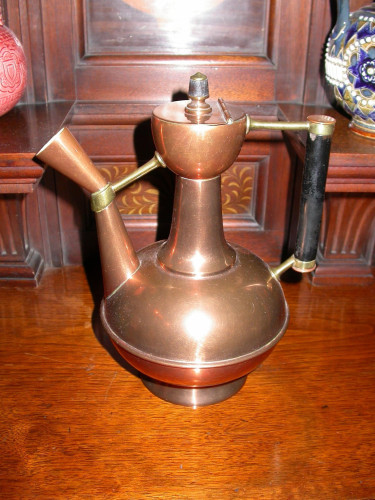
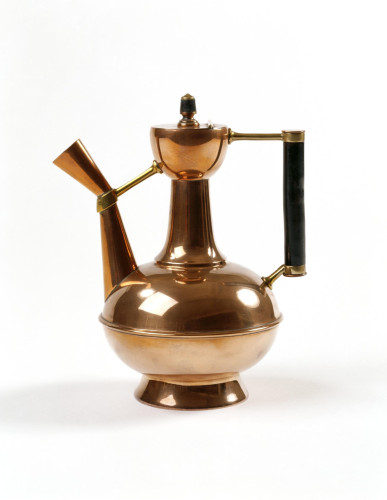
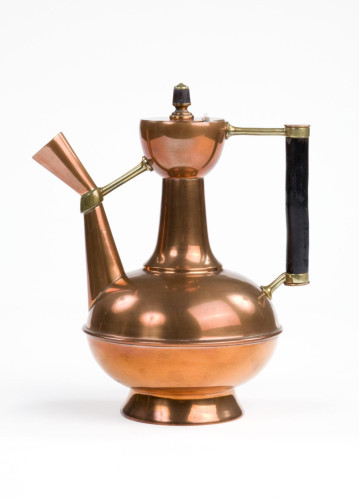
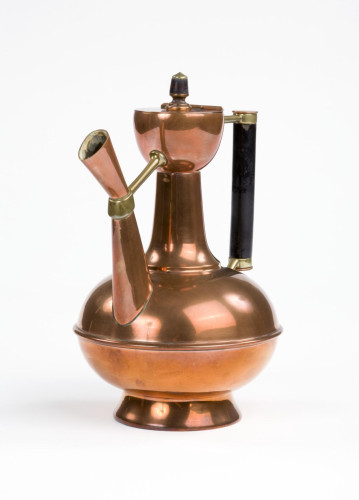
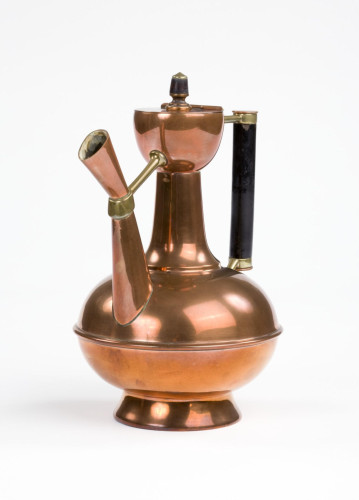
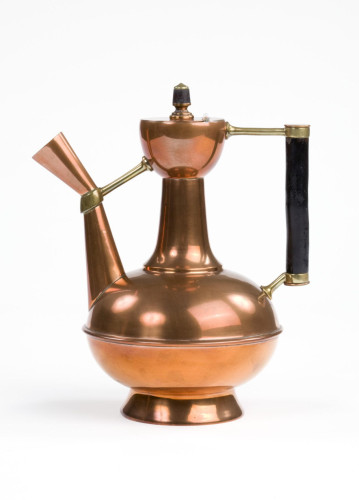
Coffee pot made from copper with a wooden handle and finial and brass mounts, designed by Christopher Dresser, and made by Benham and Froud c.1888.
Object name
coffee pot
Object number
27/1991-1
Production person
Christopher Dresser (designer)
Production organisation
Benham and Froud (manufacturer)
Production date
1888 (manufactured)
Production place
London (manufactured)
Period
Victorian (1837-1901)
Material
copper
brass
wood
brass
wood
Technique
cast
turned
turned
Physical description
Copper coffee pot with ebony handle and finial with brass mounts, inspired by Middle Eastern design.
Dimensions
Height: 22.4cm
Width: 19.8cm
Width: 19.8cm
Website keywords
serving drink
tea, coffee and chocolate drinking
tea, coffee and chocolate drinking
Label
Label text for the exhibition At Home with the World, Geffrye Museum (20 March 2012- 9 September 2012):
Coffee pot
Christopher Dresser, the Glasgow-born designer of this pot, was greatly influenced by Japanese and Islamic design. Its shape derives from a Middle Eastern water vessel, known as an ibrik, though the vertical handle and angular spout owe more to Dresser’s interpretation of Japanese design.
This object was featured in the World at Home project and display at the Geffrye Museum from 17 May to 24 July 2011. The project was a result of a collaboration between the Geffrye Museum and MA students from the Institute of Archeology, University College London. The students chose eleven objects from the museum’s period rooms to highlight the narrative of England’s ever-changing relationship with the rest of the world. Through the expansion of the British Empire and development of international trade, the English middle classes brought into their homes goods as varied as pottery from Germany, tea from China and modern furniture from Scandinavia. Other outputs of the project included design marketing materials, on-line activities, events, design activities for children and visitor and audience research.
The students researched these objects and prepared text panels for the display. The text is recorded below:
‘Truth, Beauty and Power’
The design of this coffee pot is attributed to Christopher Dresser, a designer and writer whose motto was ‘truth, beauty, power’. Dresser was a very important figure within the Aesthetic Movement. This artistic and literary movement was in part inspired by Japanese and Islamic culture, and adopted for domestic decoration as an alternative to conventional Victorian tastes. English interiors were given a new, harmonious elegance, with exotic references.
The ‘Cult of Japan’
Access to Japanese art and design was made possible when Japan’s borders were opened in 1853. Christopher Dresser actively promoted Japanese design and manufacture in England. He arranged a Japanese stand at the 1873 International Exhibition, and later visited Japan as a guest of the Emperor. The English craze for Japanese crafts and customs was also fuelled by other exhibitions such as the ‘Japanese Village’ in Knightsbridge, which opened in 1885.
Industrial Production and Consumer Culture
Dresser was in favour of industrial production and the opportunities it created for bringing affordable ‘good taste’ into the homes of the middle-classes, instead of an elite few. Department stores like Liberty’s exhibited and sold the latest fashions in interiors, making stylish furnishings available to wider audiences.
James Abbott McNeill Whistler's oil on canvas painting, dating from 1863 to 1865, entitiled La Princesse du pays de la porcelaine (The Princess from the Land of Porcelain), depicts a Victorian lady wearing a kimono and immersing herself in the atmosphere created by the Japanese objects and furniture that decorate the room.
Middle Eastern coffee pots, such as a Turkish coffee pot from the 1800s in the Victoria and Albert Museum, object number 369-1897, may have been an inspiration for the shape and materials of Dresser’s coffee pot, made of copper and brass, with which he combines his characteristic Japanese-inspired wooden handle. Coffee was in fact first brought to Europe by Turkish traders in the early 1600s.
Coffee pot
Christopher Dresser, the Glasgow-born designer of this pot, was greatly influenced by Japanese and Islamic design. Its shape derives from a Middle Eastern water vessel, known as an ibrik, though the vertical handle and angular spout owe more to Dresser’s interpretation of Japanese design.
This object was featured in the World at Home project and display at the Geffrye Museum from 17 May to 24 July 2011. The project was a result of a collaboration between the Geffrye Museum and MA students from the Institute of Archeology, University College London. The students chose eleven objects from the museum’s period rooms to highlight the narrative of England’s ever-changing relationship with the rest of the world. Through the expansion of the British Empire and development of international trade, the English middle classes brought into their homes goods as varied as pottery from Germany, tea from China and modern furniture from Scandinavia. Other outputs of the project included design marketing materials, on-line activities, events, design activities for children and visitor and audience research.
The students researched these objects and prepared text panels for the display. The text is recorded below:
‘Truth, Beauty and Power’
The design of this coffee pot is attributed to Christopher Dresser, a designer and writer whose motto was ‘truth, beauty, power’. Dresser was a very important figure within the Aesthetic Movement. This artistic and literary movement was in part inspired by Japanese and Islamic culture, and adopted for domestic decoration as an alternative to conventional Victorian tastes. English interiors were given a new, harmonious elegance, with exotic references.
The ‘Cult of Japan’
Access to Japanese art and design was made possible when Japan’s borders were opened in 1853. Christopher Dresser actively promoted Japanese design and manufacture in England. He arranged a Japanese stand at the 1873 International Exhibition, and later visited Japan as a guest of the Emperor. The English craze for Japanese crafts and customs was also fuelled by other exhibitions such as the ‘Japanese Village’ in Knightsbridge, which opened in 1885.
Industrial Production and Consumer Culture
Dresser was in favour of industrial production and the opportunities it created for bringing affordable ‘good taste’ into the homes of the middle-classes, instead of an elite few. Department stores like Liberty’s exhibited and sold the latest fashions in interiors, making stylish furnishings available to wider audiences.
James Abbott McNeill Whistler's oil on canvas painting, dating from 1863 to 1865, entitiled La Princesse du pays de la porcelaine (The Princess from the Land of Porcelain), depicts a Victorian lady wearing a kimono and immersing herself in the atmosphere created by the Japanese objects and furniture that decorate the room.
Middle Eastern coffee pots, such as a Turkish coffee pot from the 1800s in the Victoria and Albert Museum, object number 369-1897, may have been an inspiration for the shape and materials of Dresser’s coffee pot, made of copper and brass, with which he combines his characteristic Japanese-inspired wooden handle. Coffee was in fact first brought to Europe by Turkish traders in the early 1600s.
-
© Museum of the Home, London
-
© Museum of the Home, London
-
© Museum of the Home, London
-
© Museum of the Home, London
-
© Museum of the Home, London
-
© Museum of the Home, London
-