
39/1989-1
Collection
Paintings, Prints and Drawings
Brief description
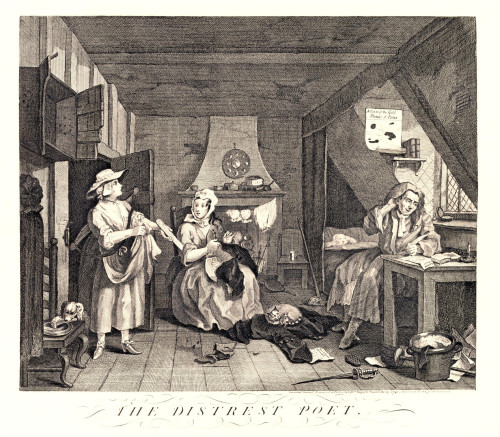
Etched engraving on paper entitled 'THE DISTREST POET' by William Hogarth, issued in London in 1741 from a plate dating from 1740.
Title
The Distrest Poet
Object name
print
print
engraving
engraving
Object number
39/1989-1
Production person
William Hogarth (artist)
Production date
1741 (published)
1740 (made)
1740 (made)
Production place
England (printed)
Period
Georgian (1714-1837)
Material
paper
pigment
pigment
Technique
engraved
etched
etched
Physical description
Etching and engraving on paper with title and publication line printed below the image.
Content description
This scene shows an impoverished writer in his one roomed garret, he is seated at a table by the window, scratching his head, struggling to write, the title of his work is, 'Riches / a poem'. Open beside him is a book by Edward Bysshe, who wrote 'The Art of English Poetry' giving advice to writers. On the wall behind the poet is a 'View of the Gold Mines of Peru' map, an indication of his desire to be rich and is juxtaposed with his poor surroundings. Several pages have been strewn across the floor underneath the table, an indication of his several drafts and unsatisfied writing.
On the floor in the foreground is a copy of The Grub-street Journal, a journal published from 1730 to 1737, the journal was a satire on ‘popular’ journalism and hack writing. Hogarth’s Distrest Poet is a direct stereotype of the ‘Grub-Street hack’ established by the early 1730s: a man who, despite his limited talent and poverty-stricken circumstances, doggedly pursues a living as a writer.
The poet's wife sits in the middle of the room darning some trousers whilst on the floor a cat and its kitten sit on top of a jacket. A lady is standing at the open door with a long bill in her hand, beside her a dog eats a bone from a chair, which is the last remaining 'food' of the family as highlighted by the empty open cupboard above the dog. In the background is a fireplace, on the chimney breast is an almsdish and on the mantelpiece are two tea bowls, a teapot, book and pestle and mortar. To the right of the fireplace is the only bed in the room in which a crying baby is lying.
On the floor in the foreground is a copy of The Grub-street Journal, a journal published from 1730 to 1737, the journal was a satire on ‘popular’ journalism and hack writing. Hogarth’s Distrest Poet is a direct stereotype of the ‘Grub-Street hack’ established by the early 1730s: a man who, despite his limited talent and poverty-stricken circumstances, doggedly pursues a living as a writer.
The poet's wife sits in the middle of the room darning some trousers whilst on the floor a cat and its kitten sit on top of a jacket. A lady is standing at the open door with a long bill in her hand, beside her a dog eats a bone from a chair, which is the last remaining 'food' of the family as highlighted by the empty open cupboard above the dog. In the background is a fireplace, on the chimney breast is an almsdish and on the mantelpiece are two tea bowls, a teapot, book and pestle and mortar. To the right of the fireplace is the only bed in the room in which a crying baby is lying.
Content object
table
newspaper
fireplace
mantelpiece
teapot
tea bowl
almsdish
book
pestle
bed
cupboard
candlestick
bellows
fire tongs
chair
tankard
newspaper
fireplace
mantelpiece
teapot
tea bowl
almsdish
book
pestle
bed
cupboard
candlestick
bellows
fire tongs
chair
tankard
Dimensions
Height: 34cm
Width: 40cm
Width: 40cm
Website keywords
tables
seating
fireplaces
images of rooms
reading
needlework
seating
fireplaces
images of rooms
reading
needlework
-
© Museum of the Home, London