21/1989-1
Collection
Ceramics
Brief description
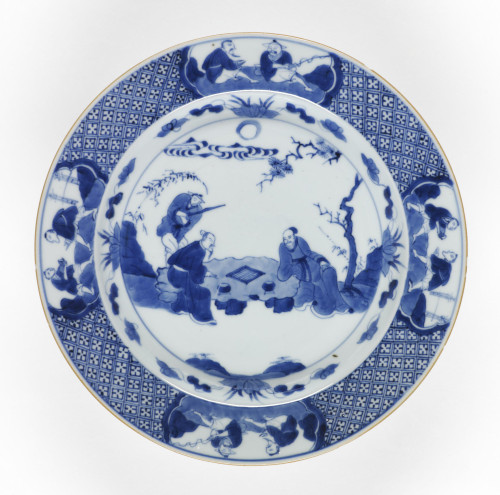
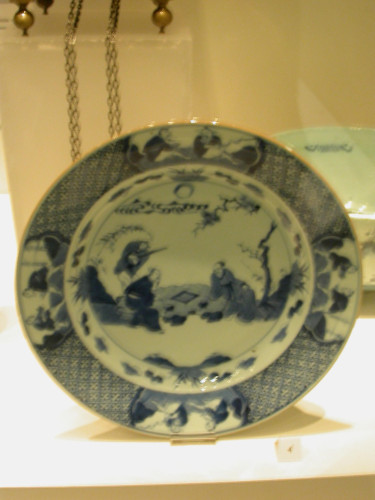
Plate made from hard paste porcelain and painted in underglaze blue with a scene showing two men playing a board game, set in a rocky landscape, the border is decorated with a diaper pattern including reserves (enclosed sections) with figures doing acrobatics and fishing. The plate was manufactured in China c.1680-1690, during the Kangxi reign (1662-1722).
Object name
plate
Object number
21/1989-1
Production date
c.1680-1690 (manufactured)
Production place
China (manufactured)
Period
Stuart (1603-1714)
Material
hard paste porcelain
glaze
pigment
glaze
pigment
glaze
pigment
glaze
pigment
Technique
painted
glazed
fired
moulded
glazed
fired
moulded
Physical description
Plate made from glazed Chinese porcelain with underglaze decoration in shades of blue.
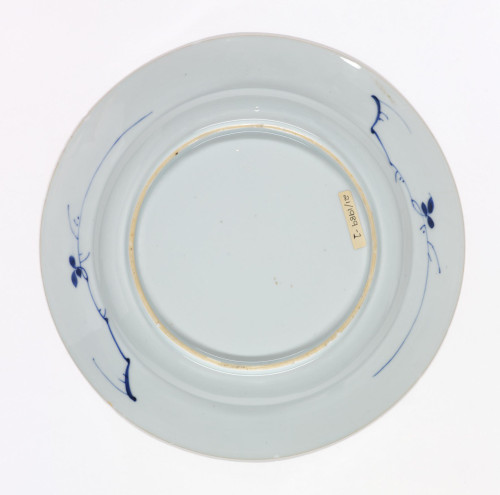
The central scene shows two seated men playing a board game, in a landscape with rocks, plants and stylised clouds. The plants include pine, prunus blossoms and bamboo. The central figures appear to be playing 'Weiqi' (more commonly known as 'Go'). There is a third figure standing to the left of the composition, possibly a servant. The border is decorated with a diaper pattern, with four reserves showing two scenes: at the top and bottom two figures are shown fishing while to the right and left two figures are shown doing acrobatics. The underside of the plate is decorated with branches and leaves.
The central scene shows two seated men playing a board game, in a landscape with rocks, plants and stylised clouds. The plants include pine, prunus blossoms and bamboo. The central figures appear to be playing 'Weiqi' (more commonly known as 'Go'). There is a third figure standing to the left of the composition, possibly a servant. The border is decorated with a diaper pattern, with four reserves showing two scenes: at the top and bottom two figures are shown fishing while to the right and left two figures are shown doing acrobatics. The underside of the plate is decorated with branches and leaves.
Dimensions
Diameter: 28cm
Website keywords
serving food
ornaments
ornaments
Label
Label text for ‘New ways of living’ case, Information Bay 2, Geffrye Museum, 2010:
Plate, Chinese, Kangxi (1662–1722)
Porcelain
Chinese porcelain, ‘china’ as it was called, was imported in large quantities and became common in the parlours of the middling sort from the late seventeenth century. It was displayed on surfaces such as the tops of cabinets and over the fireplace. A 1679 inventory of a London ‘leather-seller’s’ home records ‘some china cups upon the chimney’ in the dining room; they were probably on shelves above the fireplace.
Label text for the exhibition At Home with the World, Geffrye Museum (20 March 2012- 9 September 2012):
Plate
Hard-paste porcelain
Made in China, about 1680–1690
Plates like this one were imported to England directly from China or through European trade. Europeans were awed by the delicacy of Chinese porcelain and its ‘exotic’ decoration. It was known as china and was displayed in the home, often over the fireplace.
Plate, Chinese, Kangxi (1662–1722)
Porcelain
Chinese porcelain, ‘china’ as it was called, was imported in large quantities and became common in the parlours of the middling sort from the late seventeenth century. It was displayed on surfaces such as the tops of cabinets and over the fireplace. A 1679 inventory of a London ‘leather-seller’s’ home records ‘some china cups upon the chimney’ in the dining room; they were probably on shelves above the fireplace.
Label text for the exhibition At Home with the World, Geffrye Museum (20 March 2012- 9 September 2012):
Plate
Hard-paste porcelain
Made in China, about 1680–1690
Plates like this one were imported to England directly from China or through European trade. Europeans were awed by the delicacy of Chinese porcelain and its ‘exotic’ decoration. It was known as china and was displayed in the home, often over the fireplace.
-
© Museum of the Home, London
-
© Museum of the Home, London
-
-
-
-